Beyond the Nameplate: What Residents’ Door Displays Reveal About Home
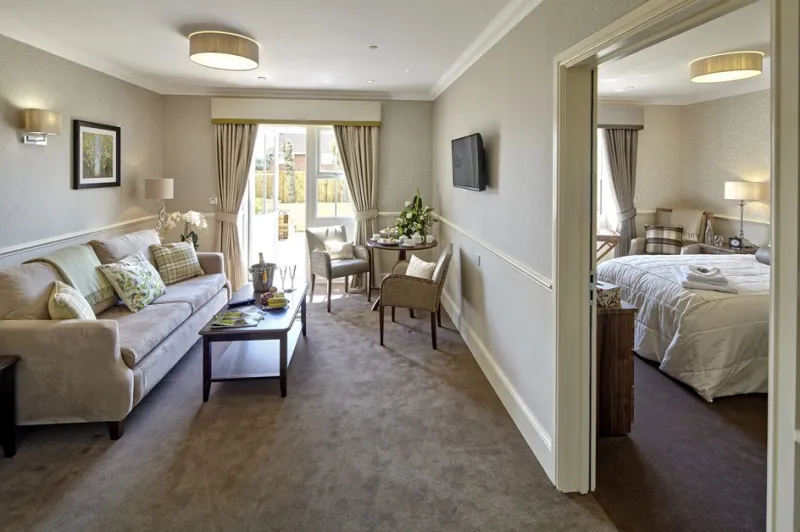
Photo: Avery Healthcare, CC BY-SA 4.0, via Wikimedia Commons
A nameplate tells you who lives in a room. The photographs, postcards, scarves and prayer cards around it tell you who that person is. At St Dorothy’s Residence, the space outside a bedroom door is never simply a corridor detail. It is one of the quiet ways a resident makes a claim on the building: this is my room, this is my history, and this is how I would like to be known.
A door as a small exhibition
Walk along a residential corridor and you will see a remarkable variety of arrangements. One door may hold a single framed wedding photograph and a rosary. Another may carry a postcard from a seaside town, a grandson’s drawing and a faded ticket from a football match. A third may be almost bare by choice, with only the standard nameplate and a small vase. None of these is more valid than the others. The point is not decoration for its own sake. It is recognition.
We often describe these displays as small museums. That phrase is useful because it captures both their modesty and their seriousness. A museum selects objects that carry meaning, labels them carefully and places them where they can be seen without being handled. A resident’s door display does something similar. It gathers a few things that matter and puts them at the threshold between private space and shared life.
Why these displays matter
Door displays do practical work as well as emotional work. They support identity by keeping visible the roles a person has held: parent, grandparent, worker, supporter of a particular team, member of a congregation, traveller, neighbour. They support orientation by helping a resident recognise their own room in a building that may still feel unfamiliar. They also support conversation. A photograph of a wedding, a postcard from a favourite place or a child’s painting gives staff, visitors and other residents an easy point of connection. It offers a way into talk that does not begin with health or routine.
For families, this can be a relief. When a relative moves into residential care, there is often a fear that the details of their life will be smoothed away. A door display is a small, visible answer to that fear. It says that the person is still surrounded by evidence of their own story.
How St Dorothy’s supports personalisation
At St Dorothy’s, personalising a door is an invitation, not an expectation. Some residents want a rich display; others prefer a single photograph or nothing at all. Staff discuss the option during settling in and revisit it as circumstances change. We keep a small supply of removable hooks, display boards and protective sleeves so that families do not have to improvise with unsuitable fixings.
We also encourage residents to choose the objects themselves wherever possible. A well-meaning family may arrive with a large collage, only to find that their relative would rather have one picture of the dog. The resident’s preference is the starting point. Staff can help by asking simple questions: what would you like people to see first? Is there anything you would rather keep inside the room? Would you like this changed with the seasons?
Dignity, privacy and consent
A corridor is a semi-public space. That means door displays need to respect privacy as well as celebrate identity. We avoid displaying information that identifies a resident to strangers or reveals personal details they have not chosen to share. Photographs of children are particularly sensitive. Families should be confident that any image of a young person is displayed with the consent of those with parental responsibility.
Residents may also change their minds. A display that felt right in the first week may feel too exposed later. Staff check in about this gently and without making a fuss. The aim is for the door to remain the resident’s own, not a permanent exhibition curated by others.
Fire safety and practical limits
The corridor is also an escape route. This places firm limits on what can be displayed. Nothing may obstruct a vision panel, fire signage, a door closer or the clear width of the corridor. We do not permit fixings that damage fire doors or require nails, screws or strong adhesive. Items must be secure enough not to fall and light enough not to cause injury if they do. Battery candles, fairy lights and anything with a heat source are not appropriate.
These constraints are not obstacles to personalisation; they are part of doing it well. A well-planned display can be deeply personal and still meet the standards that keep everyone safe. Where a family is unsure, a member of staff can advise on suitable frames, sleeves and positions.
A family checklist for meaningful displays
When choosing objects for a door, less is often more. A useful display tends to have a clear focus and a small number of strong items rather than many small pieces. Families may find the following checklist helpful.
- Choose two to five items with genuine significance: a photograph, a postcard, a small piece of fabric, a prayer card, a certificate or a child’s drawing.
- Prefer copies or good-quality prints for anything valuable or irreplaceable.
- Keep the resident’s nameplate visible and unobstructed.
- Check that nothing blocks the vision panel, signage, door closer or corridor width.
- Use removable, approved fixings rather than nails, screws or strong adhesive.
- Avoid glass that could break and heavy objects that could fall.
- Ask the resident what they want to see and what they would rather keep private.
- Review the display after a few weeks and change it with the seasons if that feels right.
Room 14 and the wider home
One resident’s door in Room 14 has become a quiet talking point: a small collection of postcards, a football scarf and a photograph of a much-loved dog. None of it is expensive. All of it is specific. Staff know to ask about the dog. Visitors pause at the postcards. The resident has a way of saying, without saying it directly, that this is home.
That is the standard we aim for across St Dorothy’s Residence. A door display is not a test of family devotion or a measure of how much a resident has brought with them. It is a small, practical expression of belonging. When it is done with care, it helps a room feel less like an allocated space and more like a place someone has made their own.