A Square of Daylight: The Quiet Importance of a Bedroom Window in Residential Care
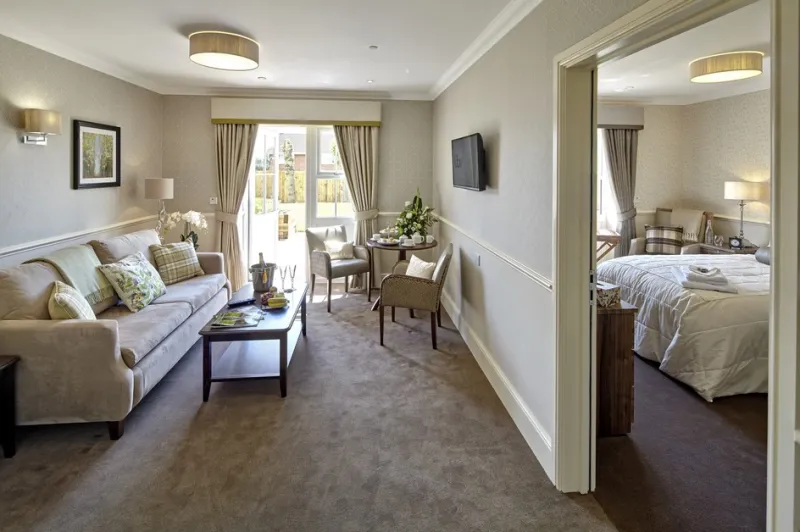
Photo: Avery Healthcare, CC BY-SA 4.0, via Wikimedia Commons
Moving into a residential care home brings many new sights and sounds. Among the quietest, and often the most reassuring, is the view from a bedroom window. At St Dorothy’s Residence, we have come to see that a square of glass can do more than let in daylight. It can help a new resident work out where they are, give families something to talk about, and make a room feel less like a stopgap and more like a place of one’s own.
The first view of a new room
On the first afternoon in a new room, staff will often ask which way the window faces. It is a simple question, but it opens up a useful conversation. Some residents arrive able to describe exactly what they would like to see: a tree, a bit of road, a church tower, a bus stop, a patch of garden. Others are less sure until they have sat for a while.
The view does not need to be beautiful in a postcard sense. A wall, a path, a strip of sky and the tops of houses can be enough. What matters is that it is legible — that something changes during the day and the resident can follow those changes. A window that shows the weather, the light and a little human activity gives the day a shape.
Why a view helps with orientation
Orientation is not only about knowing the date. It is also about knowing the shape of the day. Morning light falling across a curtain, the postman’s van at the kerb, the smell of rain through an opened window, the first streetlight coming on: these are small markers, but they help to place a person in time and place.
For people living with dementia, a familiar view can act as a gentle anchor. It may prompt a memory, a question or a moment of recognition. Staff can help by learning the view themselves. If a resident says that the bins are being put out, it helps if the carer knows that bin day is Tuesday and can respond with interest rather than a blank look. That kind of shared knowledge turns a view into a conversation.
The British weather, shared and reliable
British weather is often treated as a joke, but in a care home it is a useful social currency. It gives residents and visitors something neutral to discuss and something real to observe. A robin on the sill, rain driving against the glass, a pale winter sun, a gust that moves the hedge: all of these are small events, and small events are often easier to talk about than feelings.
Families can use the view as a bridge. ‘What is it like out your window?’ is often an easier question than ‘How are you feeling?’ It invites a concrete answer. A daughter can bring in a postcard of the sea and place it beside the glass; a son can mention that the allotments look flooded; a grandchild can report on the first frost. These details do not solve anything, but they keep a person connected to the world beyond the room.
A sill that works, not a shelf that crowds
The instinct to bring things in is generous, and it comes from love. But a windowsill is not a storage solution. Too many objects can make a room feel busy, obscure daylight and create practical problems. They can also be confusing for a resident who is trying to make sense of a new space.
A few principles help. Keep the sill clear enough for the window to open and close safely. Avoid blocking vents or radiators. Do not place heavy, fragile or electrical items where they might be knocked, and never place candles near curtains. Check with staff before adding anything that needs fixing to the wall or frame. In a care setting, small decisions about safety are part of ordinary care, not an obstacle to it.
Choose three or four objects with meaning rather than a row of ornaments. A framed photograph, a small plant if it is allowed, a postcard, a smooth stone from a former garden, a barometer that still works: these are enough. A small pair of binoculars can be useful for watching birds, but they should be stored safely and only used with the resident’s agreement. If a bird feeder is possible outside the window, staff can advise on whether the building allows it and who will keep it clean.
Privacy, safety and the resident’s own choice
A window is also a boundary. Residents have a right to privacy, and the view may include neighbours, a car park or a street. Curtains and blinds should be easy to use, and staff should consider a sheer blind or net curtain where the room looks directly onto another building. The aim is not to shut the world out, but to let the resident decide how much of it they wish to see and be seen by.
Choice matters here as much as anywhere else. Some residents will want the sill arranged with care; others will prefer it almost empty. Some will enjoy a daily weather note; others will find it unnecessary. Families should ask before rearranging anything, and staff should record what the resident prefers. A view is personal, and the best version of it is the one the resident has chosen.
Small rituals around the glass
At St Dorothy’s Residence, the window often becomes part of the daily routine without anyone making a grand plan. A resident may like to sit by it after breakfast, or watch for the evening light. A carer may note the first frost on the inside of the glass, or open the window for five minutes of fresh air. A visitor may comment on the jackdaws on the roof.
These are modest rituals, but they hold a day together. They also give families a way to stay close. A short phone call about the weather is not trivial; it is a shared observation, and shared observations build familiarity. Over time, the view becomes part of the resident’s story of the room: the tree that lost its leaves, the bus that was late, the neighbour’s cat that crossed the path every afternoon.
A window is not a substitute for company, conversation or care. But it is a quiet companion. It offers light, movement and a sense of place. If you are visiting someone at St Dorothy’s Residence, take a moment to ask what can be seen from the window today. The answer may tell you more about how they are than a longer question would.