The Hour That Belongs to You: Individual Bedtimes in Residential Care

Photo: Shixart1985, CC BY 2.0, via Wikimedia Commons
In residential care, bedtime can easily become an administrative event: a fixed hour, a familiar sequence of tasks, a corridor of doors closing one after another. Yet sleep is not a task to be completed. It is a personal matter, shaped by lifelong habits, health needs, preferences and the simple fact that people are different. At St Dorothy’s Residence, the evening is therefore approached not as a single routine imposed on everyone, but as a period of choice, support and quiet attention.
A routine is not a timetable
There is a useful distinction between routine and timetable. A routine offers reassurance: the same friendly faces, the same offer of a warm drink, the same help with getting ready for bed. A timetable insists that these things happen at one appointed hour. The first supports dignity; the second can undermine it.
Residents at St Dorothy’s Residence are encouraged to say when they would like to retire. For some, that may be shortly after supper. For others, it may be much later, after a favourite programme, a chapter of a book or a telephone call with family. Staff do not treat an early night as virtuous or a late night as troublesome. Both are simply expressions of how a person wishes to live.
The evening as a sequence of choices
The evening often works best when it is broken into small, unhurried choices rather than presented as a single instruction to get ready for bed. Would a resident like a cup of tea now, or later? Would they prefer to wash and change before supper, or afterwards? Is the television helping them to relax, or would they rather have the radio on low? These questions are not frivolous. They are the everyday material of autonomy.
At St Dorothy’s Residence, staff aim to offer these choices without making them feel like a test. A resident who says “not yet” is not being difficult. A resident who changes their mind is not causing a problem. The purpose of the evening is to help the person feel settled, not to complete a checklist efficiently.
Drinks, medication and practical care
Practical care still has its place. Evening drinks may need to be considered alongside continence, hydration and sleep. Tea and coffee are part of British life, but their timing can matter, and staff will discuss alternatives such as a milky drink or water if a resident wishes. Medication rounds are handled with the same attention to individual preference and clinical need, with pain relief and other regular medicines given as prescribed and any concerns reported appropriately.
Personal care is also offered with privacy and explanation. A resident may prefer to prepare for bed at their own pace, with the door closed and with as much independence as they are able to manage. Where help is needed, staff explain what they are doing and why. The aim is not to rush a person towards sleep, but to make the process of getting ready feel calm and dignified.
Light, noise and the fabric of the building
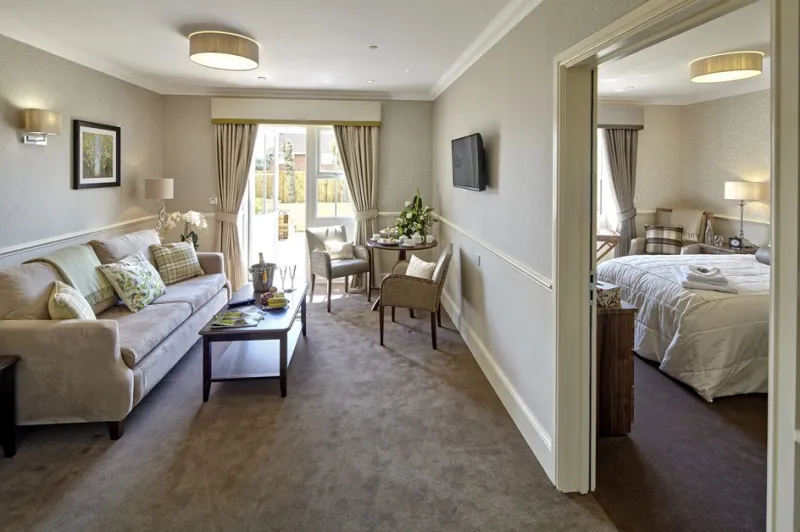
Bedrooms should feel like places of retreat. That means attending to the details that shape sleep: a lamp beside the bed rather than only an overhead light, curtains that close properly, a comfortable room temperature, and a call bell within reach. Corridor lighting may need to remain low rather than bright, and doors should be closed with care. The ordinary sounds of a shared building – a trolley, a door, a television in a neighbouring room – are part of residential life, but they can be reduced or explained.
Staff also recognise that some residents sleep better with a little background sound, while others need quiet. A radio on low, a familiar audiobook or a nightlight may be helpful for one person and distracting for another. The starting point is always the resident’s own account of what helps.
Handover after dark
Good bedtime care depends on good communication. At St Dorothy’s Residence, the handover to night staff includes not only clinical tasks and call-bell instructions but also the smaller facts that make a difference: who prefers to read for a while, who may want a drink in the night, who is unsettled by a bright corridor light, who likes the door left slightly ajar. These details are not incidental. They allow night staff to provide care that feels continuous with the day rather than merely supervisory.
Night staff also understand that waking is not always a problem to be solved. Some residents wake briefly and settle again; others may need reassurance, a drink or help with positioning. The response should be calm, unhurried and respectful of the person’s room as their own space.
Night owls and early risers
Residential life can sometimes favour the early riser: breakfast is served, curtains are opened, the day begins. At St Dorothy’s Residence, there is room for the night owl too. A resident who prefers to read until midnight, listen to the radio or simply enjoy the quiet of their own company should not be made to feel that they are holding up the day. Equally, an early riser should not be kept waiting for a cup of tea because a timetable says otherwise.
This flexibility requires thought from staff, but it is not complicated in principle. It rests on the belief that bedtime is a matter of personal choice within a safe and well-supported environment.
What good sleep requires
Good sleep is not produced by a single rule. It is supported by comfort, safety, familiarity and a sense of control. A resident who feels rushed, infantilised or anxious about “causing trouble” is less likely to rest well. A resident who is asked what they would like, and whose answer is respected, is more likely to feel at ease.
The last cup of tea should not signal that the day must end for everyone at once. At St Dorothy’s Residence, the evening belongs to the people who live here: to their habits, their preferences and their right to a good night in their own time.